Античките корени на Хјумовиот скептицизам
Клучни зборови:
Hume, Ancient scepticism, naturalism, moral scepticismАпстракт
Does Hume take essential elements from ancient scepticism in his method of inquiry? - is the main question that is treated in this article. The discussion on this problem not only opens methodological issues, but also questions Hume's fundamental philosophical concepts, mainly concentrating on the dualism between scepticism and naturalism. Hume's hesitation between pyrrhonist and academic scepticism doesn't make the investigation easier. As a thorn on Hume's side is the moral scepticism that brings him on naturalist ground. However, taking into consideration his supposition that all rational operations are processes that don't have fundamental principles, lead us only to pyrrhonistic conclusions. If we test Hume's pyrrhonism on the grounds of accepting natural dispositions, it will certainly fail, but if we accept that these dispositions are psychological barriers, then pyrrhonism is safe. The nature itself doesn't refute pyrrhonism; it only makes it beyond our beliefs. In that context, naturalism and scepticism in Hume's case can come along.
Референци
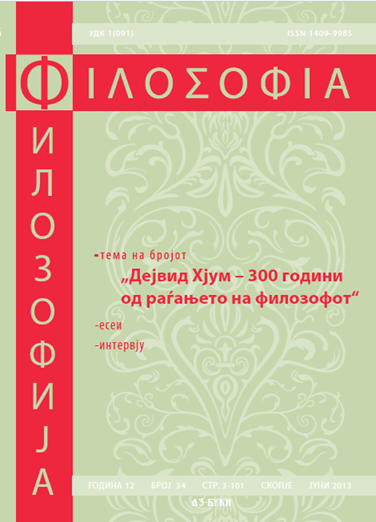
Преземања
Објавено
Издание
Секција
Дозвола
Авторско право(c) 2013 Филозофија

Овој труд е лиценциран како Creative Commons Attribution 4.0 International License.